The satellites that can talk to an ordinary phone, and one that can’t yet. What each looks like, how high it flies, how it reaches your phone and who it works with.
Written by a mobile network insider with over 13 years in GSMGSM Global System for Mobile communications: the 2G standard from 1991 that started it all, and the base that SMS, roaming and SIM cards were built on. Glossary, from IVR and SMS to call routing and thin and thick MVNOsMVNO Mobile virtual network operator: a brand that sells mobile service over someone else’s network. A thin MVNO mostly resells; a thick MVNO runs its own core network, SIMs and billing. Glossary.
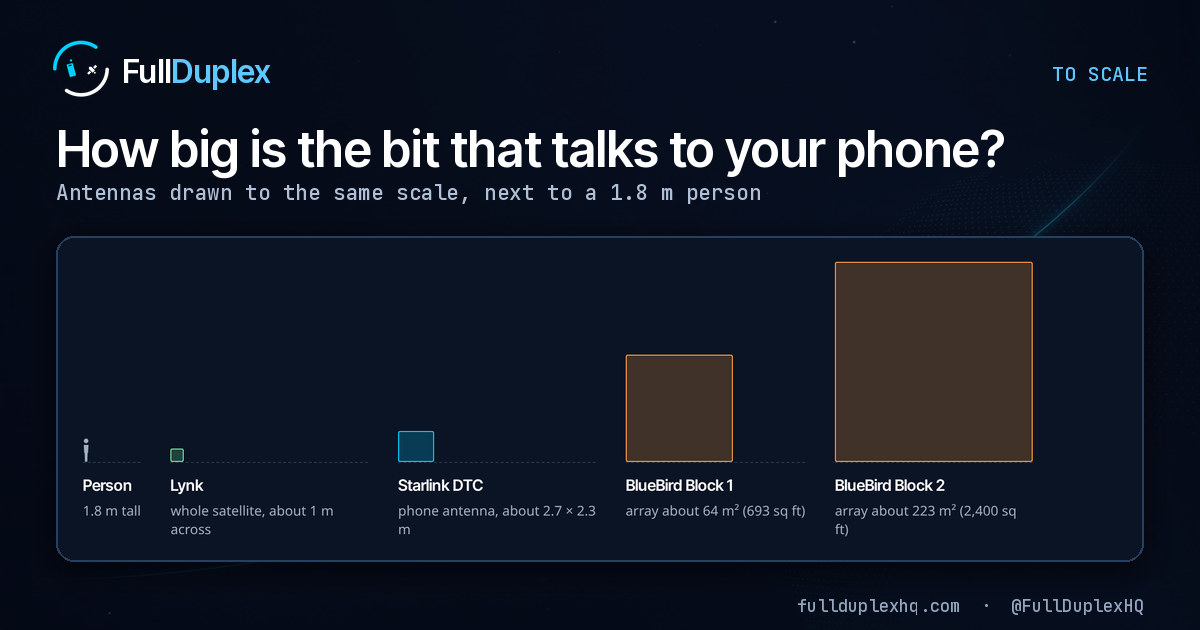
Bigger antennas can hear a phone’s weak signal from further away. Drawn to the same scale, next to a 1.8 m person. BlueBird squares have the same area as the real arrays.
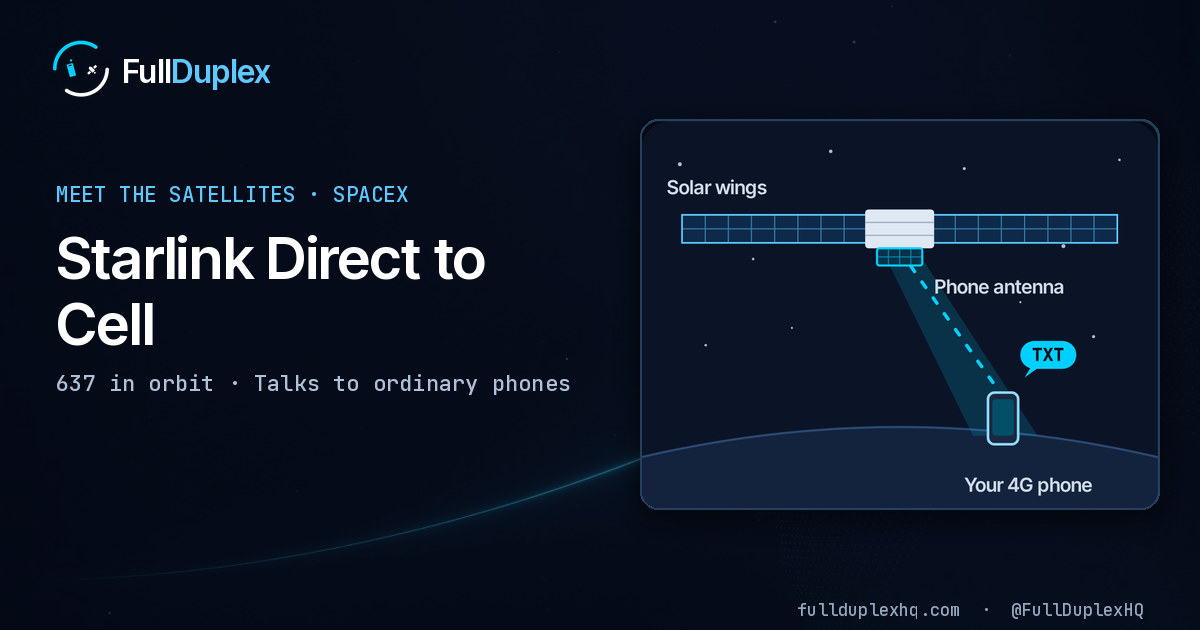
It borrows your own network’s 4G frequencies, so an ordinary 4G phone connects as if it were roamingRoaming Using another network when yours isn’t there, usually abroad. Satellite-to-phone works much like roaming: your phone attaches to a partner network that happens to be in space. Glossary. In the UK, O2 Satellite uses 5 MHzMHz Megahertz, a million cycles a second: how radio frequencies are measured. Lower frequencies (say 700 MHz) travel further and get through better; higher ones carry more data. Glossary of O2’s 1800 MHz spectrumSpectrum The range of radio frequencies. Governments license slices of it, and who owns which slice decides who can talk to your phone, which is why satellite firms team up with mobile networks. Glossary. Each satellite can point 48 beams down and listen with 16. Source: Starlink Mobile (SpaceX), accessed 13 Nov 2026 · ISPreview, 19 Aug 2026 (Ookla beam study)
What you can do today
Texts, data for 40+ selected apps, and voice calls through apps such as WhatsApp. Ordinary (native) phone calls are a future step. Source: Starlink Mobile (SpaceX), accessed 13 Nov 2026
Who it works with
T-Mobile (US), VMO2 (UK), Rogers (Canada), One NZ, Telstra, KDDI, NTT Docomo, SoftBank, Kyivstar, Entel, Globe, Airtel Africa, Deutsche Telekom and more. Source: Starlink Mobile (SpaceX), accessed 13 Nov 2026
Illustration drawn by Full Duplex from public descriptions. Not to scale.
AST SpaceMobile
Talks to ordinary phones · testing
BlueBird (Block 1 and Block 2)
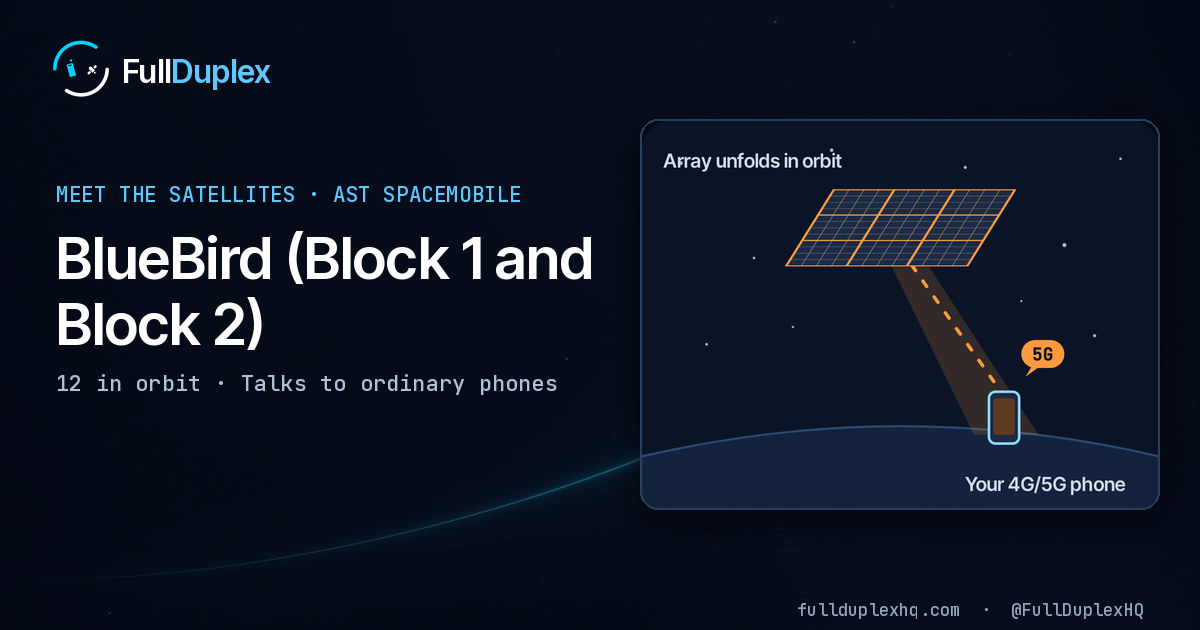
Few satellites, but enormous ones. Each BlueBird unfolds a huge flat antenna, so it can hear a normal phone’s weak signal from hundreds of kilometres away.
A giant flat square panel, folded for launch and opened in orbit. The side facing Earth is covered in small antennas; the back carries solar cells. Source: TechSpot, 15 Nov 2022 (BlueWalker 3 array)
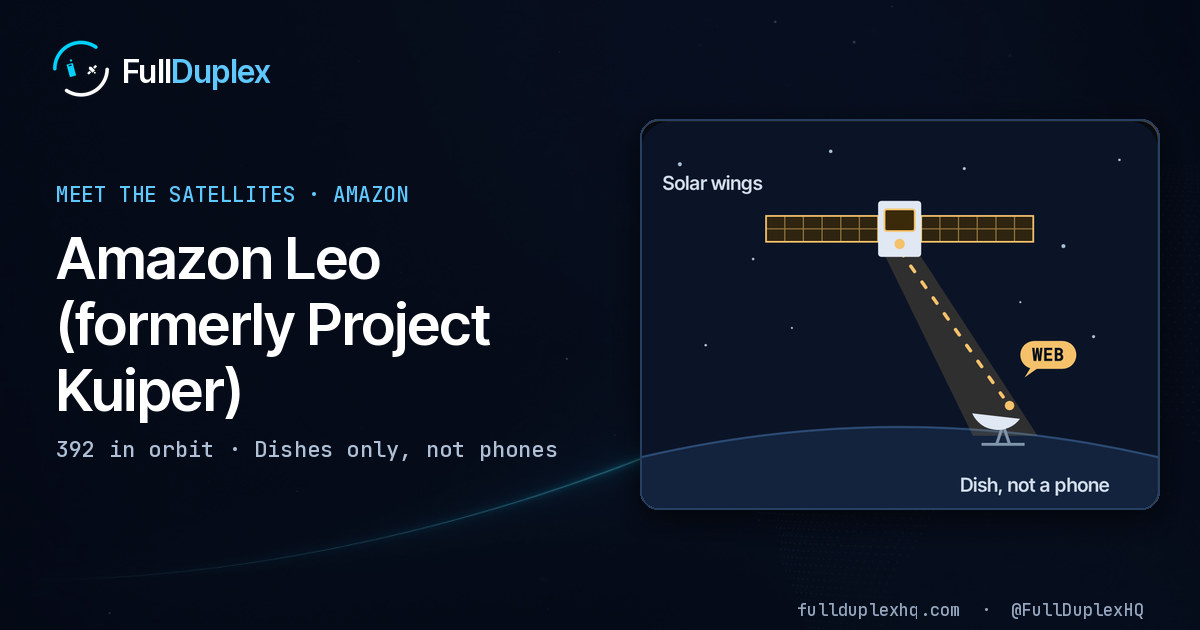
High-frequency Ka-band links to customer antennas and ground stationsGround station A dish site on Earth that links satellites to the internet and to the mobile network’s core. With a bent-pipe satellite, your call or message comes down here before it goes anywhere else. Glossary. That is why a phone can’t use it directly. Source: Wikipedia: Amazon Leo (citing the FCC authorisation)
What’s next: Amazon has filed with the FCC for a separate phone network of up to 5,105 satellites using Globalstar’s spectrum, with deployment starting in 2028. Source: Amazon, 27 Jul 2026 (Leo direct-to-device plan)
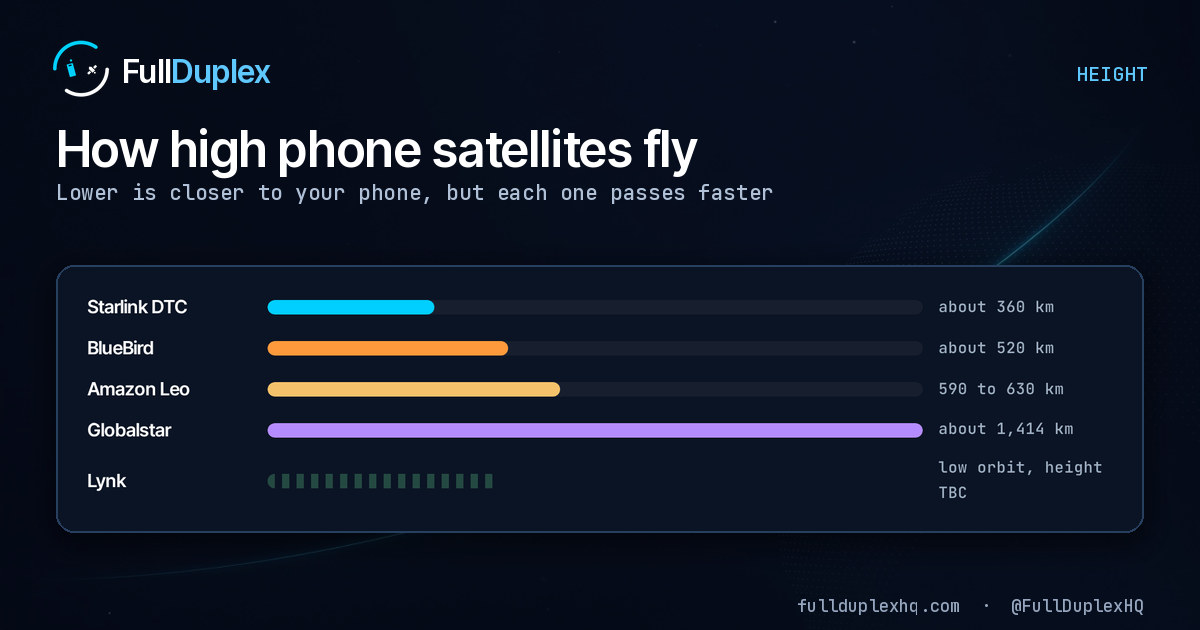
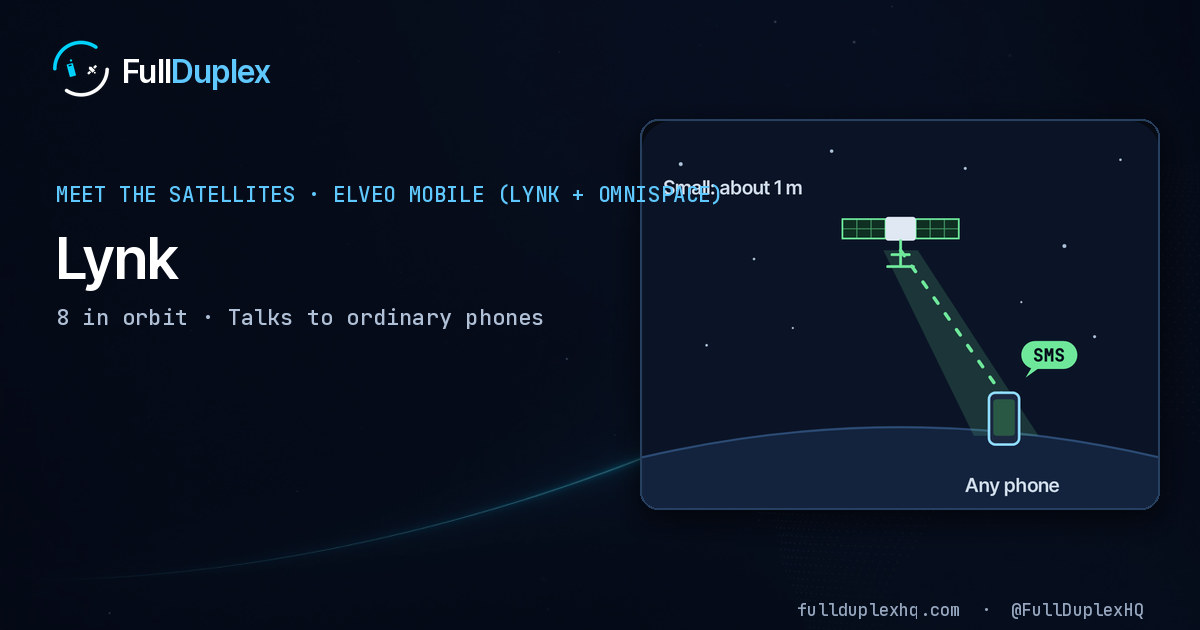
Low Earth orbitLEO Low Earth orbit: roughly 500 to 2,000 km up. Close enough for a phone’s weak signal to reach, but each satellite crosses the sky in minutes, so you need hundreds of them. Glossary on a near-polar path (about 97°), going round roughly every 94 minutes. Exact height: TBC. Source: KeepTrack: Lynk satellite bus, data as of 13 Nov 2026
How it reaches your phone
It works with standard, unmodified phones through partner networks. The merged company, Elveo, also holds rights to 60 MHz of satellite S-band spectrum and says it supports 2G, 4G, 5G and IoT devices. Source: Lynk, 12 Mar 2024 · Light Reading, 17 Aug 2026
56 contracts with mobile networks and distribution partners in more than 60 countries. Elveo is testing with ten operators. Source: Light Reading, 17 Aug 2026
What’s next: Elveo plans 320 new low-orbit satellites from late 2027, with commercial service in early 2028. Source: Light Reading, 17 Aug 2026
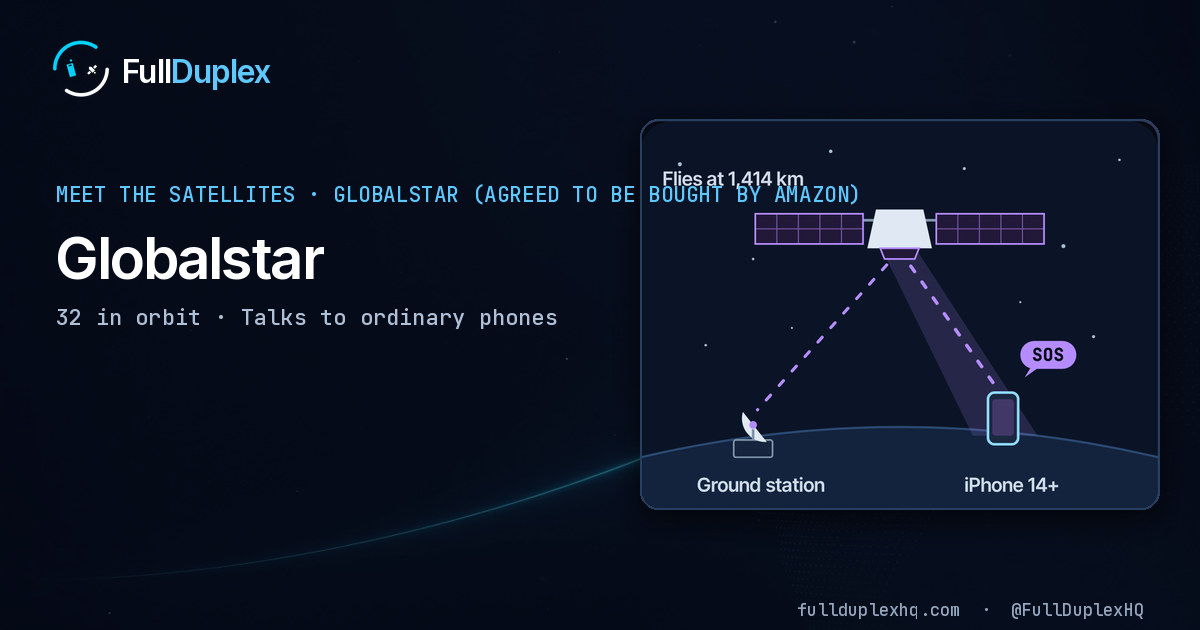
On iPhone 14 or later: Emergency SOS, messages to friends and family, Roadside Assistance and Find My location updates. A message can take 30 seconds or more to send. Source: Apple Support: connect to a satellite with your iPhone
Sources are listed with each satellite above. Satellite counts come from our launch tracker and change with every launch.
Checked 13 November 2026. Illustrations are drawn by Full Duplex from public descriptions and are not to scale. Where we couldn’t find a reliable figure we say TBC. Watch the next launches on our launch tracker.
Know someone who thinks every satellite is the same? Send them this.
One email a week on satellite-to-phone, mobile networks and what it means for you, from a mobile network insider with over 13 years in GSM. Plain English, with sources.