See a launch the way the webcasts show it: the climb, each stage event and the moment the satellites are let go. Then see where the newest satellites are right now.
Watch the explainerStarship Flight 15 in three 30-second animations: hot staging, satellite release and the tower catch.
The clock counts to the launch time in our launch data, refreshed every 6 hours. Speed and altitude follow the planned profile as if the rocket flies exactly on time and on plan. They’re our estimates, not readings from the rocket.
What happens, step by step
T+0:00:00Liftoff Nine Merlin engines lift Falcon 9 off the pad.
T+0:01:07Max-Q Peak aerodynamic stress on the rocket.
T+0:02:25Main engine cutoff (MECO) The first stage’s nine engines shut down.
T+0:02:29Stage separation First and second stages separate.
T+0:02:35Second stage engine start (SES-1) The second stage’s single engine lights.
T+0:02:56Fairing separation The two fairing halves fall away; SpaceX recovers them from the sea.
T+0:06:01Booster entry burn The first stage relights three engines to slow down as it falls back through the atmosphere.
T+0:08:23Booster landing The first stage lands on a droneship at sea, ready to fly again.
T+0:08:39Second stage engine cutoff (SECO-1) The second stage reaches orbit and coasts.
T+0:52:58Second stage restart (SES-2) A one-second burn to trim the orbit.
T+1:01:49Starlink satellites deploy The whole stack of flat-packed Starlink satellites is released at once. They then drift apart and use their own thrusters to spread out and climb.
After deployment
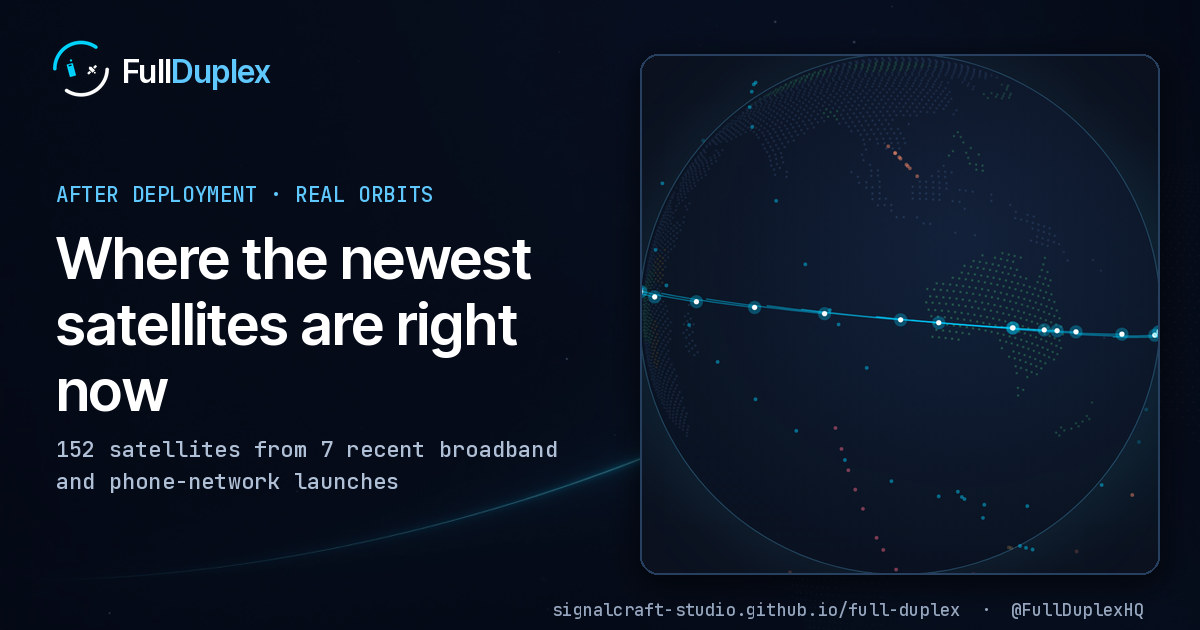
Where the newest satellites are right now
Each dot is a real satellite launched in the last 30 days for a broadband or phone network, placed using its latest published orbit. A fresh batch flies as a tight “train”, then spreads out around the orbit over the following weeks.
Orbits: CelesTrak GP data, fetched (152 satellites from 7 recent broadband and phone-network launches). Positions are computed in your browser with satellite.js (SGP4). They’re typically within a few kilometres near the data’s date, and drift if a satellite fires its thrusters.
Real orbits, computed in your browser. Heights to scale; dots enlarged. Drag to spin.
Why new satellites spread out
Rockets drop a whole batch of satellites in one place. To cover the planet, each satellite needs its own slot, so over the following weeks they use small thrusters to climb to slightly different heights. Lower satellites go round faster than higher ones, so the batch slowly stretches into a line, then a ring.
Why it matters for your phone: a satellite only helps your phone when it’s overhead. Until a new batch has spread out and reached its working height, it adds little coverage. That’s why a launch today usually means better gaps-in-signal coverage weeks later, not tonight.
Signal · free weekly briefing
Get launch alerts in Signal
Signal is our free weekly direct-to-cell briefing: the launches that matter for your phone, in one email a week.